
.png)
Modern Manhood: Navigating Culture, Tradition, and Identity

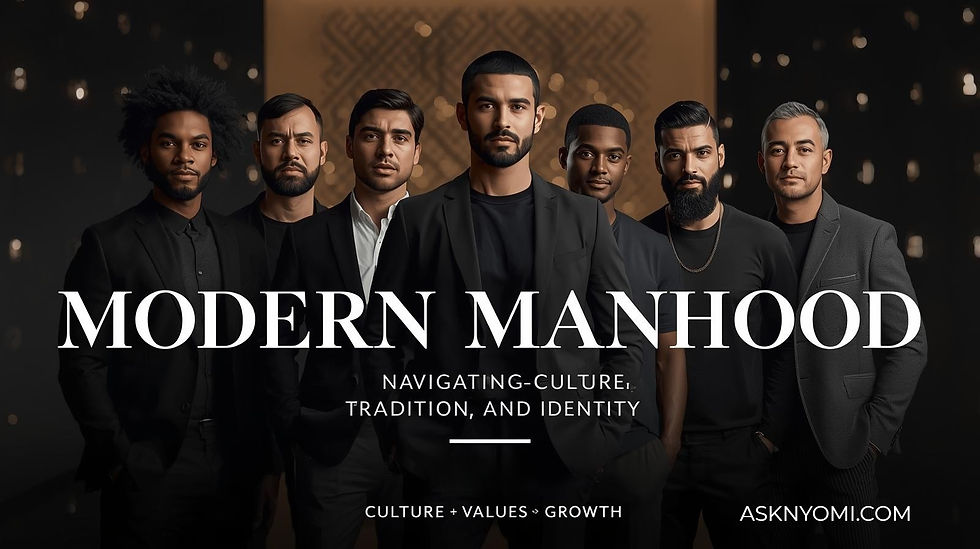
What does it actually mean to be a man in today's world? For a lot of guys, that question feels heavier than ever—and the weight isn't coming from one direction. It's coming from everywhere. Society throws out mixed messages: be tough, but be vulnerable; lead, but don't dominate; be ambitious, but don't lose your soul; provide for your family, but be emotionally present; be confident, but not arrogant.
And here's what nobody talks about enough: the confusion isn't just about what manhood looks like—it's about who gets to define it in the first place. There are voices from every corner telling men who they should be, what "real masculinity" means, what makes someone "man enough." Some say it's about sexual orientation. Others say it's about how much money you make or how much you can bench press or whether you cry or whether you don't.
But here's the truth I've learned working with men from all walks of life: manhood isn't about any of that. It's about character. It's about integrity. It's about the wholeness of who you are when you stop performing for everyone else and start living as yourself. The truth? There's no single blueprint for modern manhood, and that's both freeing and frustrating. So let's talk about it—the real, unfiltered truth about what it means to navigate manhood today.
The Unwritten Rules—and the Pressure to Break Them
"The tragedy is not that we are different. The tragedy is that we are taught that being different means being less than."
From the time we're young, men are handed a script. It gets passed down through fathers, coaches, media, locker room talk, and cultural expectations that nobody wrote down but everyone seems to know. Don't cry. Be strong. Provide. Compete. Win. Never show weakness. Never ask for help. Never be "too much" of anything that doesn't fit the narrow definition of what a man is supposed to be.
But as culture shifts—as conversations about mental health, emotional intelligence, and authentic living become more mainstream—many men find themselves caught between honoring those old-school values and wanting something more real. They want connection, not just competition. They want purpose, not just paychecks. They want the freedom to express the full range of who they are without being told they're doing masculinity wrong.
Conflicting Expectations: The Impossible Balance
Society can celebrate a man for being a provider, then criticize him for working too much and not being present at home. Show emotion—but "not too much." Be assertive—but not aggressive. Be confident—but not cocky. Be a leader—but don't overshadow others. Be ambitious—but don't neglect your relationships. The line keeps moving, and it's easy to feel like you're always getting it wrong no matter what you do.
And then there's the added layer: the judgment about who even gets to be considered a "real man." I see it all the time—in personal conversations and across social media—people dictating what manhood is based on who you love, how you express yourself, whether you fit a particular masculine aesthetic. As if being heterosexual makes you "more of a man" than someone who's gay or bi. As if there's only one way to embody masculinity.
This is where we need to get real: manhood isn't about your sexual orientation. It's not about performing a certain version of masculinity that makes other people comfortable. It's about the content of your character, the integrity of your actions, and your willingness to show up as your full, authentic self. That's it. That's the metric.
The Loneliness Factor: Isolated by Design
Modern men are more likely to feel isolated than ever before. They're expected to figure things out alone, to be self-sufficient to the point of disconnection, even though true strength is often found in community and brotherhood. Vulnerability is encouraged in theory but rarely modeled in ways that feel safe or authentic.
Men are told: "Be vulnerable. Open up. Express your feelings." But when they do, they're often met with discomfort, dismissal, or judgment. They're told they're being "too sensitive" or "too emotional" or that they need to "man up." So they learn to keep it inside. They learn that the script they were handed—the one that says real men handle everything alone—might have been right after all.
But here's what I know from working with men in coaching: that isolation is killing them. It's killing their relationships, their mental health, their ability to lead authentically, and their capacity for joy. The loneliness isn't a sign of strength—it's a symptom of a system that taught men that connection is weakness. And it's time to rewrite that narrative.
Culture in Motion: Rewriting the Narrative
"The most courageous act is still to think for yourself. Aloud." —Coco Chanel
The good news? Culture is shifting. The conversations are changing. More men are stepping forward to challenge the old narratives and model what integrated, whole masculinity looks like. These are men who understand that being a man isn't about choosing between strength and softness—it's about embodying both. It's about knowing when to be the protector and when to be the nurturer. When to lead and when to follow. When to speak and when to listen.
Redefining Strength: Beyond the Outdated Playbook
It's no longer just about physical power or stoicism. Real strength is being able to own your story, admit mistakes, and support others. Strength is looking at the parts of yourself you've been taught to hide and choosing to integrate them instead. Strength is saying "I don't have all the answers" and seeking wisdom. Strength is being present with your partner when they're hurting instead of trying to fix it. Strength is crying when you need to cry and laughing when you need to laugh and knowing that your humanity doesn't diminish your masculinity—it completes it.
This is the healing work: acknowledging fully who you are and embracing both sides of the scale. Not just the provider or protector, but also the nurturer when it's needed. Not just the warrior, but also the healer. Not just the stoic, but also the feeler. Modern manhood isn't about abandoning one for the other—it's about integrating all of it into a complete, authentic expression of self.
What integrated masculinity looks like:
• Strength with tenderness: You can be fierce in protecting what matters and gentle in how you love. These aren't contradictions—they're complements.
• Provider and nurturer: You don't have to choose between supporting your family financially and being emotionally present. You can do both.
• Confident and humble: You know your worth and you're still learning. You lead with assurance and you ask for help when you need it.
• Emotional and rational: You think with your head and feel with your heart and use both to make wise decisions.
This integration—this wholeness—is what makes a man truly powerful. Not the performance of masculinity, but the authentic embodiment of it.
New Role Models: Expanding the Definition
From athletes like LeBron James—who's open about mental health, community work, and showing up for his family—to everyday men who show up for their families, challenge injustice, mentor younger men, and aren't afraid to cry or admit when they're struggling, the definition of "real man" is expanding.
We're seeing men normalize therapy, talk about depression and anxiety, advocate for paternity leave, challenge toxic workplace cultures, support their partners' ambitions as fiercely as their own, and model emotional literacy for their sons and daughters. These men aren't less masculine because they feel deeply—they're more human because they allow themselves to.
The new role models show us:
• Vulnerability is courageous: Sharing your struggles doesn't make you weak—it makes you real and relatable.
• Service is strength: Using your platform, resources, and energy to lift others is the highest form of leadership.
• Growth is ongoing: The best men never stop learning, evolving, and challenging themselves to be better.
• Character defines you: Not your bank account, not your body count, not who you love—but how you show up, how you treat others, and whether you keep your word.
These men are rewriting what's possible. And in doing so, they're giving permission for the next generation to do the same.
Forging Your Own Path in the Noise
"To be yourself in a world that is constantly trying to make you something else is the greatest accomplishment." —Ralph Waldo Emerson
Here's the thing about all these competing messages, all these people telling you who you should be: none of them have to live your life. You do. And the most radical thing you can do in a world full of scripts and expectations is to be authentically, unapologetically yourself.
Authenticity is Rebellion
In a world that tries to box you in, being your true self is an act of courage. You don't have to fit the old mold or the new one—just your own. You don't have to prove your manhood to anyone. You don't have to perform masculinity in a way that makes others comfortable. You don't have to hide parts of yourself that don't fit someone else's narrow definition of what a man should be.
Authenticity means you get to define what manhood means for you. Maybe that means you're the guy who loves fixing cars and also cries during movies. Maybe you're the corporate exec who does yoga and writes poetry. Maybe you're the stay-at-home dad who's building your family's foundation while your partner climbs the career ladder. Maybe you're the artist, the activist, the introvert, the life of the party, the quiet leader, the loud advocate.
All of it is valid. All of it is masculine. All of it is enough. The question isn't "Am I man enough?" The question is "Am I being true to who I actually am?"
Blending Old and New: Honoring Your Roots While Growing
It's possible to respect your roots and still create a vision of manhood that feels right for you. You can honor what your father taught you about responsibility while also giving yourself permission to express emotions he couldn't. You can appreciate the value of traditional masculine traits like discipline, protection, and provision while also embracing the parts of yourself that are nurturing, creative, and vulnerable.
This isn't about rejecting everything that came before or blindly accepting everything that's new. It's about discernment. It's about taking what serves you and leaving what doesn't. It's about asking: What values from tradition still resonate with me? What new perspectives expand my understanding of who I can be?
Blending old and new might mean:
• Being the emotional rock for your family while also seeking therapy for yourself
• Valuing hard work and discipline while also prioritizing rest and mental health
• Being a protector and provider while also being the first to say "I need help"
• Honoring your father's lessons about integrity while creating your own definition of success
• Respecting cultural traditions while questioning the parts that no longer serve you
This is the path forward: not either/or, but both/and. Not rejection or blind acceptance, but conscious integration. You get to decide what you keep and what you release. You get to build your own blueprint.
The Healing Work: Becoming Whole
Let's talk about the part that often gets overlooked in conversations about masculinity: the healing. Because the truth is, many men are walking around wounded—carrying pain from childhoods where they were told to "be a man" when what they needed was to be held. Carrying shame from moments when they showed emotion and were punished for it. Carrying the weight of expectations they never asked for and roles they're not sure they want.
True manhood requires healing work. It requires looking at the parts of yourself you've suppressed, the emotions you've buried, the needs you've ignored. It requires acknowledging that the armor you built to protect yourself might now be the thing keeping you from real connection.
The healing journey includes:
• Grieving what you didn't get: The father who wasn't emotionally available. The permission to feel that was never granted. The softness that was shamed out of you.
• Reclaiming what you lost: The parts of yourself you abandoned to fit in. The dreams you gave up to meet expectations. The authenticity you traded for approval.
• Integrating what you avoided: The emotions you were taught were unmasculine. The vulnerability you were taught was weakness. The softness you were taught was shameful.
• Rewriting the narrative: The stories you tell yourself about what makes you worthy. The beliefs about what makes you "man enough." The definitions of success that were never yours to begin with.
This is deep work. This is sacred work. And this is the work I do with my clients—creating space for men to be fully human, to express the full range of who they are, to heal the wounds that traditional masculinity inflicted, and to step into an integrated version of manhood that honors all of who they are.
Real Talk: Questions for Your Journey
These questions are designed to help you reflect on where you are in your own journey of defining manhood. Be honest. Be curious. And remember: there are no right answers—only your answers.
On Identity and Expectations:
• Have you ever felt like you're "not man enough" by someone else's standards? What was happening in that moment, and whose voice were you hearing?
• What parts of yourself have you hidden or suppressed to fit someone else's idea of what a man should be?
• If you could define manhood for yourself—completely free from others' opinions—what would it look like?
On Pressure and Performance:
• Where do you feel pressure to perform masculinity in a certain way? At work? In relationships? With friends? On social media?
• What would it look like to let that go? What's the fear underneath the performance?
• When was the last time you allowed yourself to be fully authentic without worrying about judgment?
On Role Models and Growth:
• Who are your role models for modern manhood, and what do they teach you?
• What qualities do you want to embody that you didn't see modeled growing up?
• What's one step you can take this week toward a more integrated, authentic expression of who you are?
The Ongoing Journey
There's no finish line for figuring out what it means to be a man today. This isn't a problem to solve—it's a journey to walk. The work is ongoing, the questions evolve, and the answers change as you grow. And that's not a flaw in the system—that's the beauty of it.
The journey is about questioning, growing, and supporting each other as we all try to write a new script—one that's true to who we are, not just who we're told to be. It's about building communities where men can be vulnerable without judgment, strong without being rigid, successful without sacrificing their souls.
It's about recognizing that manhood isn't a monolith. It's not one way of being, one way of loving, one way of showing up. It's as diverse as the men who embody it. And the sooner we embrace that truth—the sooner we stop policing each other's masculinity and start celebrating each other's authenticity—the freer we'll all be.
So take the quiz.
Explore where you are on the spectrum. Get curious about the parts of yourself you've been hiding. Challenge the narratives that no longer serve you. And remember: the most masculine thing you can do is be authentically, courageously, unapologetically yourself.
Your version of manhood is valid. Your journey is valid. You are enough, exactly as you are.
Always Keep it So Sexy (A.K.I.S.S)
—Nyomi Banks



Comments